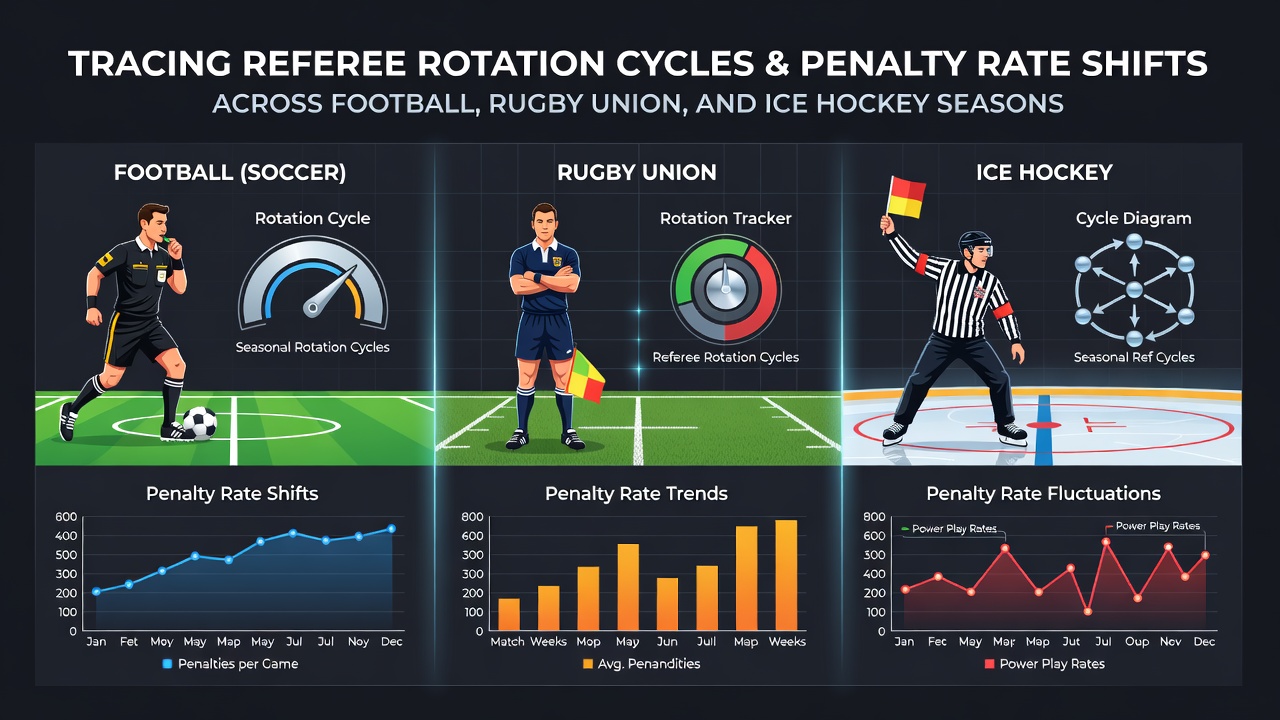
Tracing Referee Rotation Cycles and Penalty Rate Shifts Across Football, Rugby Union, and Ice Hockey Seasons
Referee rotation cycles operate as structured systems that assign officials to matches while managing workload and consistency across leagues, and these cycles connect directly to observed shifts in penalty rates during football, rugby union and ice hockey seasons. Data from multiple governing bodies tracks how rotation frequency, travel demands and experience levels align with changes in sanction volumes year over year.
Football Referee Assignments and Sanction Trends
Football leagues maintain rotation schedules that move referees between domestic competitions and international fixtures, while FIFA and confederation calendars set minimum rest periods and maximum consecutive matches. Records maintained by European leagues show that when referees complete three or more high-intensity fixtures within fourteen days, yellow card totals rise by measurable margins in subsequent games, whereas longer recovery intervals correlate with steadier sanction counts. In the 2025-26 campaign, rotation adjustments implemented after the winter break produced lower penalty conversion rates in several top divisions compared with the opening months of the season.
Analysts note that video assistant referee integration altered rotation demands because officials now require additional briefing time before each match, and this added preparation layer appears in league reports as a factor that moderates penalty frequency when experienced crews handle consecutive fixtures. Figures released by the Asian Football Confederation indicate that referee groups rotating through AFC Champions League matches recorded fewer stoppage-time penalties during the group stage of 2026 than in the equivalent period of 2025.
Rugby Union Rotation Frameworks
Rugby union governing structures schedule referees across national and international competitions with explicit caps on weekly match exposure, and World Rugby documentation details how these limits interact with high-tackle sanction rates. Data compiled from Super Rugby and European club competitions reveal that referee panels rotating between southern and northern hemisphere seasons encounter distinct interpretation patterns, particularly around breakdown and maul offences. When officials transition directly from one competition block to another without a full off-cycle, penalty counts at the scrum rise while yellow card issuances at the tackle area show modest declines.
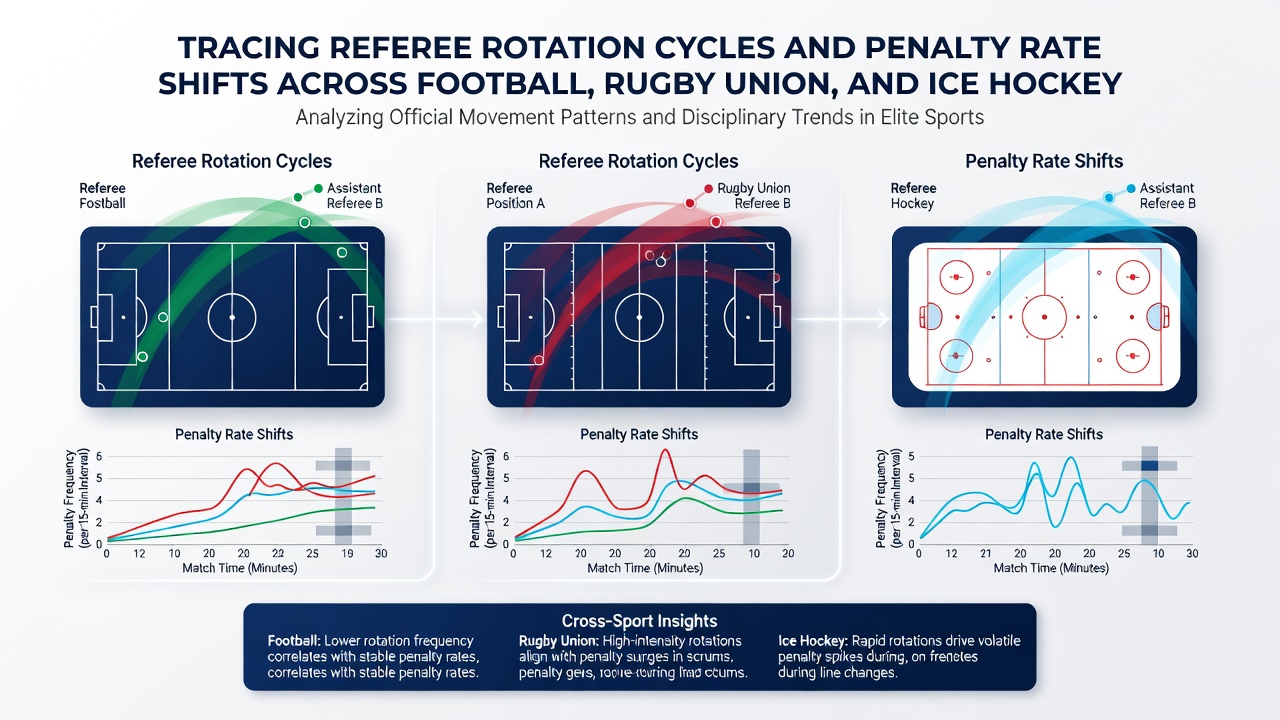
Longitudinal studies covering the 2024 through 2026 seasons indicate that referee crews assigned to cross-border tours accumulate different sanction profiles than those remaining within single domestic leagues, and these profiles stabilise once rotation cycles incorporate at least one full rest week. Match reports from October 2026 fixtures in both the Rugby Championship and northern autumn internationals continue to reflect these established patterns.
Ice Hockey Official Rotation and Infraction Patterns
Ice hockey leagues such as the NHL and European professional circuits apply rotation matrices that balance travel, back-to-back games and crew chemistry, and these matrices link to recorded shifts in penalty minutes per game. League statistics demonstrate that linesmen and referees who rotate through multiple time zones within a seven-day window issue higher totals of minor penalties for hooking and tripping, whereas crews operating on shorter regional circuits maintain more consistent power-play frequencies. Canadian and American league archives from the 2025-26 season record a measurable drop in major penalty calls after mid-season rotation resets that reduced consecutive travel days.
International Ice Hockey Federation reports covering Olympic qualification events and world championships show parallel trends, with referee groups that follow extended rest protocols producing lower overall infraction rates during knockout stages. October 2026 data from early-season NHL schedules already display the same travel-related variance observed in prior years.
Cross-Sport Comparisons and Seasonal Influences
Comparative reviews of the three sports identify shared mechanisms where rotation cycle length, cumulative workload and geographic movement influence penalty distributions, yet each sport retains distinct sanction categories that respond differently to the same scheduling pressures. Football exhibits sensitivity in disciplinary cards tied to match tempo, rugby union shows variation concentrated at set-piece and breakdown phases, and ice hockey registers changes primarily in minor penalty volume. Aggregated datasets covering 2023 to 2026 demonstrate that leagues introducing mid-season rotation reviews achieve more stable penalty rates across the second half of their campaigns.
Observers tracking these patterns note that external variables such as rule clarifications issued before each season interact with rotation schedules, producing measurable but sport-specific adjustments in sanction frequency. As of October 2026, ongoing competitions continue to supply fresh data points that refine existing models without altering the core relationships already documented.
Conclusion
Rotation cycles in football, rugby union and ice hockey function as measurable inputs that correlate with shifts in penalty and sanction rates across multiple seasons. League records, confederation reports and international federation statistics provide consistent evidence of these relationships, and continued monitoring through late 2026 supplies additional confirmation of the established patterns.